the artist

Léonard Tsuguharu Foujita (1886-1968)

A fascinating and inspiring figure, an unclassifiable Franco-Japanese creator, Foujita is one of the most famous artists of the École de Paris, whose work expresses an aesthetic fusion unique in the history of 20th-century art.

His style and originality captivated the Parisian elite of the Roaring Twenties and his friends in Montparnasse: Cocteau, Desnos, Dufy, Laurencin, Modigliani, Soutine, Zadkine…

His artistic and intimate world represents a successful fusion of East and West, making him an iconic figure in the friendship between France and Japan. A multifaceted artist, he embodies, in turn, the image of the perfectionist painter, the photographer open to the world, the extravagant dandy-stylist, and the artisan who works magic in everyday life.

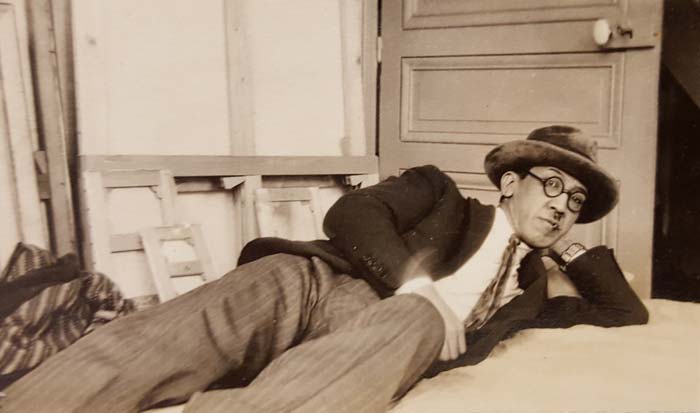
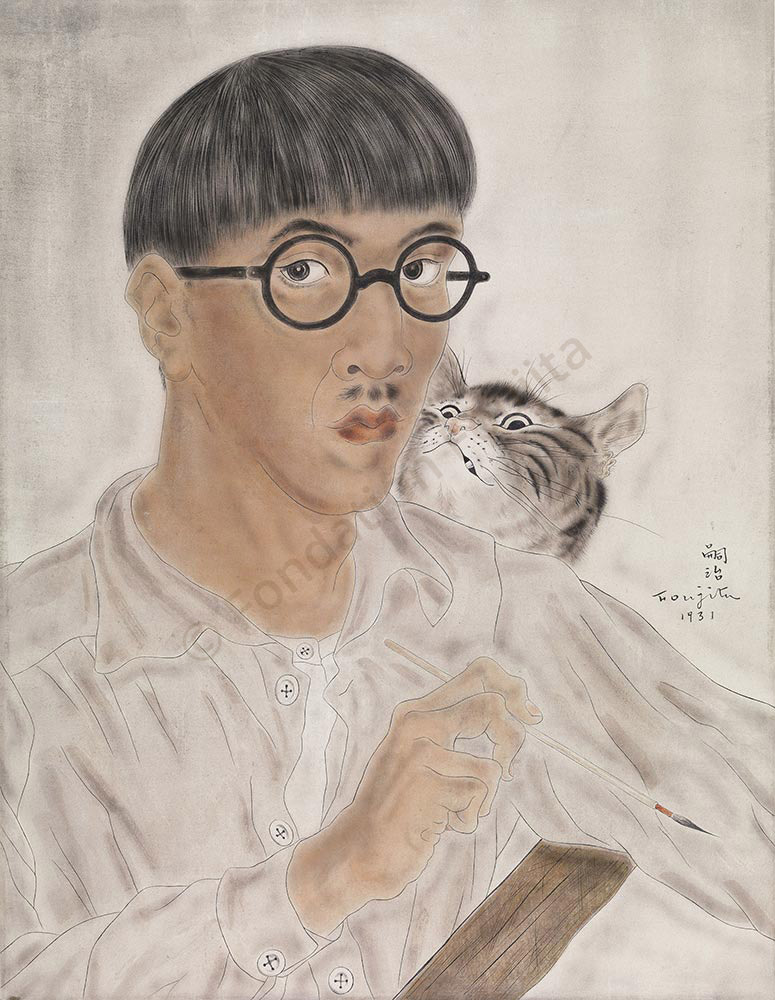
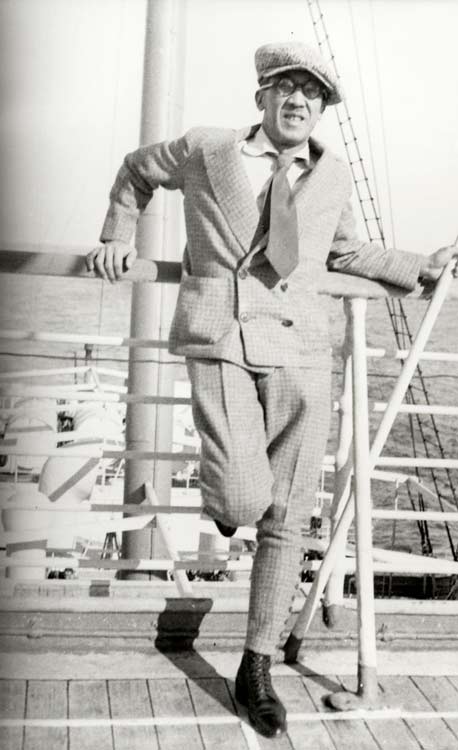
Known for his famous haircut, his round glasses and his sometimes extravagant clothes, he also charms with his kindness and humor. A citizen of the world, Foujita traveled extensively in France, Europe, North Africa, the United States, Latin America and, of course, Southeast Asia. Every step of the way, he enjoys observing people in all their diversity and everyday life, capturing them in their singular humanity.

Foujita

“People predicted that I would become Japan’s greatest painter, but I dreamed of becoming Paris’s greatest painter. I had to go back to my roots…”

“As soon as I got back from Picasso’s place, I walked into my apartment and threw all my paints and painting supplies on the floor. It was only the second day since I’d arrived in Paris, and already I was trying to forget all the techniques I’d learned in Japan — from how to hold a palette to how to wash brushes...”

“Most artists, like Matisse and Braque, painted with a broad brush. Unlike them, I began painting with a fine brush. Everyone was using lots of beautiful colors. But I sought to paint lightly, and in black and white.”

Key dates

1886

Born November 27 in Tokyo.

1913

Arrival in Paris. Foujita hangs alongside Zadkine, Modigliani, and Soutine.

The 20s

A golden age for Foujita: the consecration and perfection of his art. He adopted the famous milky white backgrounds that enhanced his female models, such as Kiki de Montparnasse. Foujita becomes one of the most famous artists. He met Lucie Badoud in 1923, and renamed her Youki “neige rose”. She became his muse and companion.

1925

Foujita is made a knight of the Legion of Honor.

1931

Departure for a world tour: USA, Central America, Latin America, China, Indochina and Japan. At each stage, Foujita met with success.

1939

Back to Paris with Kimiyo, his last wife. The war forced them to leave France on May 23, 1940.

1950

Final return to France with Kimiyo on February 14.

1955

French naturalization on February 28.

1959

Conversion to Catholicism with his baptism in Reims Cathedral on October 14.

1961

Installation in his home-whorkshop at Villiers-le-Bâcle in Essonne.

1963 - 1966

Design and decoration of the Chappelle Notre-Dame-de-la-Paix, known as the “Chapelle Foujita” in Reims.

1968

The artist dies on January 29 in Zurich.
His body lies in the “Chapelle Foujita”.